
Burnt Hill in The New York Times
The timing of this one is incredible. Three days after celebrating Burnt Hill Farm’s first birthday, The New York Times included the Chef’s Counter on The Restaurant List 2026, its annual collection of 50 favorite restaurants in America.
I knew Eric Asimov had visited us in June. He made his own reservation, took the train down from New York with his wife, ate at the counter, paid for their meal, and left. There was a no follow-up afterward. I’ll admit, I had it somewhere in the back of my mind that someone like Eric probably doesn’t take the train from New York to a little farm in Maryland for nothing. But months passed, and that was that. So seeing Burnt Hill appear in The New York Times this week was a genuine and pretty overwhelming surprise.
In introducing this year’s list, the Times writes about the difference between a restaurant and a great restaurant. A great restaurant, they say, becomes “a place like no other.” Their team traveled the country looking not simply for great food, but for “that feeling.” I’ve been thinking about that, because we never set out to build a restaurant. We set out to build the most beautiful farm.
I still remember standing on this hill for the first time in 2016, looking out over the Appalachians and imagining what it could become. We were searching for land where we could grow truly great wine in Maryland, but the picture in my head was always bigger than a vineyard. I imagined integrating animals, growing food, people gathering, wine being made from the hillside beneath their feet, and all of it existing together. For a long time, it was mostly imagination.
Today, the Chef’s Counter is the clearest expression of that idea. Twelve seats overlooking the farm. Our chef-partner, Tae Strain, and our culinary team cooking from the Chesapeake watershed. Lisa and our team making wines made from this hillside. Ingredients coming from our fields and from farmers we admire around us. Even the ceramic plates are made with clay dug from the farm. Nothing exists in isolation, and that’s really the point.
So to read Eric’s description of an evening here, and to know that he experienced what all of us have been working so hard to create, means more to me than I know how to say. None of this belongs to one person. It belongs to Tae and the culinary team who have built something extraordinarily thoughtful at the counter; to Lisa, who's spent years trying to understand what this hillside wants to say through wine; to Ashli and our hospitality team, who think endlessly about how a person feels when they’re here; and to our farm crew, who tend the vines, animals, fields, equipment, and a million things guests will never see. It belongs to the people washing dishes after everyone has gone home, the servers setting tables before anyone arrives, and everyone noticing the small details that make a place feel considered. Most of their names will never appear in an article, but their fingerprints are all over Burnt Hill. The Times experienced a dinner. Behind that dinner is a decade of work by people who care deeply about what happens here.
There’s another layer to this moment that’s harder for me to separate from everything else. There was a period not very long ago when I was given about a 5% chance of surviving long enough to see Burnt Hill open. Leukemia, brain surgery, two bone marrow transplants, and years of treatment changed my relationship with time in ways I’m probably still learning to understand. There were years when this farm had to wait and when the future felt anything but guaranteed.
So yes, I’m enormously proud. This is a dream come true and a milestone I’ll remember for the rest of my life. But underneath the pride is an even stronger feeling of gratitude. I’m grateful to be alive to see it. Grateful to work alongside my wife, sisters and our families, and to watch talented people take an idea and make it far better than it ever could have been in my head. And grateful for every person who has visited and experienced Burnt Hill.
Burnt Hill has only been open for a year. In so many ways, we’re still figuring it out. I hope that never stops.
Recognition like this isn’t a finish line. If anything, it feels like encouragement to keep going: to give talented people room to do meaningful work, to care about the details, and to keep building a place that could only exist here.
But I do want to let this one sink in for a moment. Our kitchen on a hill was recognized by The New York Times as one of its 50 favorite restaurants in America right now.
To everyone who helped bring this place to life, and to everyone who has supported us along the way, thank you. What a gift it is to see a vision manifest, and what a privilege it is to still be here imagining what comes next with the people I love.
With gratitude,
-Drew Baker, farmer and founding partner
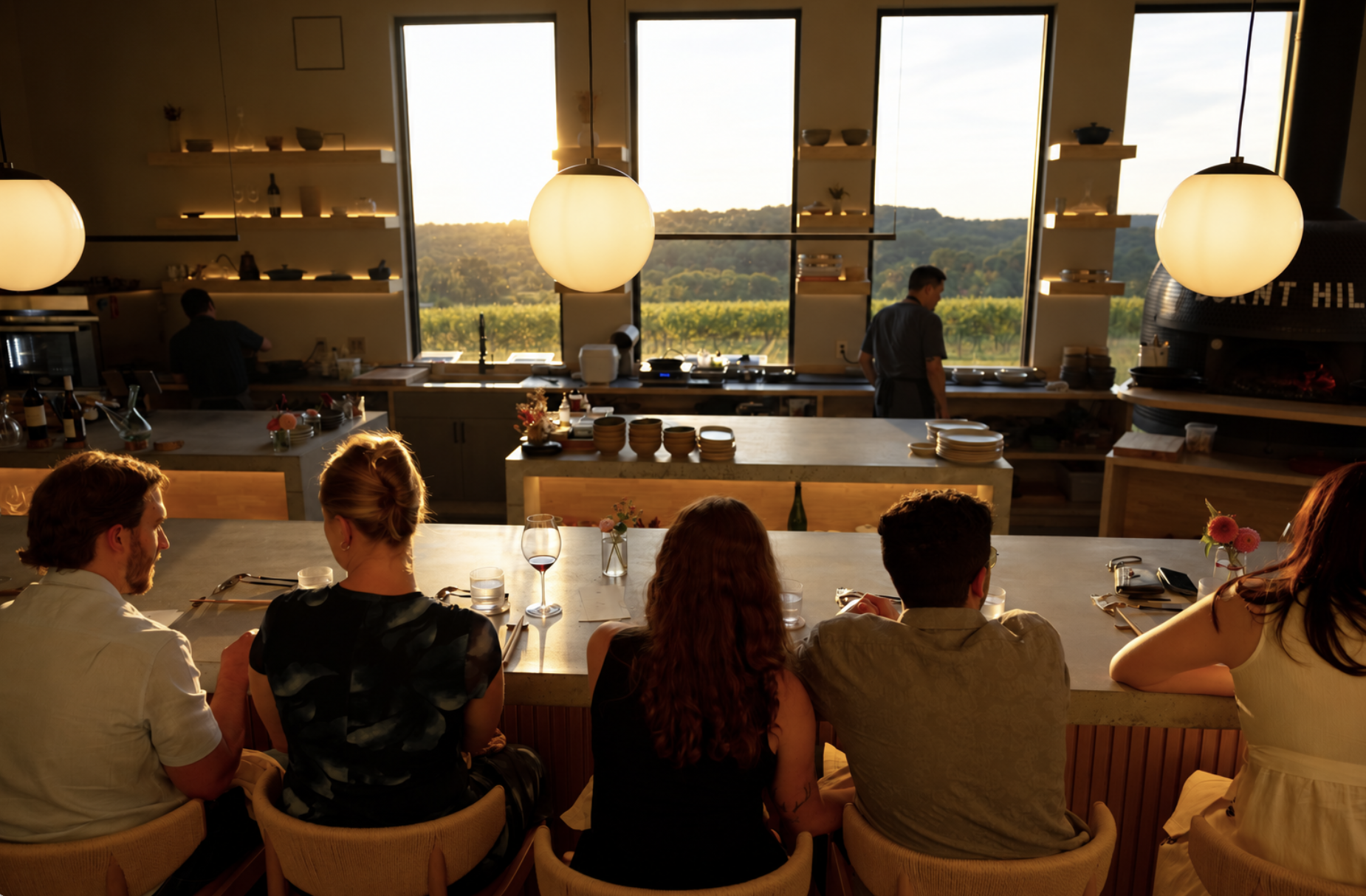
Sunset at Chef’s Counter