
Regenerative Viticulture
What is Regenerative Viticulture?
Regenerative viticulture at Burnt Hill Farm begins with a simple idea: a vineyard is a living ecosystem. Vines, soil, animals, microbes, insects, people, water, and climate are all part of the same organism. The role of the farmer is to participate in a system intelligently and humbly.
We think of regeneration as a relationship. One that asks us to give more to the land than we take, and to measure success in long term vitality.
Over the years, our approach has been shaped by six guiding principles that now form the backbone of how we farm Burnt Hill.
First, you must love it.
This sounds obvious, but it is foundational. Love is intelligent. It is curious, grateful, attentive, and patient. It drives us to learn, to observe, and to seek harmony rather than control. The same way human relationships break down when one side only takes, our collective relationship with the natural world has been damaged by extraction without reciprocity.
Farming with love changes the questions you ask. Instead of asking how much can I get from this land, you start asking what does this land need from me. That shift alone solves more environmental problems than any single technology or input ever could.
Second, stay humble and cultivate wonder.
Every farm is a classroom. No matter how long you have been doing this, the land will always know more than you do. The moment you think you have it figured out is usually the moment you stop paying attention.
One of the most formative experiences in my farming life was attending the Josephine Porter Institute for Applied Biodynamics with my mom in 2016. We stayed in a tiny cabin and spent days learning from Joseph Brinkley about soil life, preparations, and ways of working with natural forces that were completely foreign to me at the time. It was paradigm shifting. Not because I adopted everything I learned immediately, but because it reminded me how much there still was to learn.
Regenerative farming requires childlike curiosity. You have to stay open to ideas that challenge your assumptions. You have to observe before you intervene. You have to be willing to say I do not know the answer but I will find it.
Third, know what you are working with.
It is impossible to improve soil if you do not understand its current state. Most vineyards are planted based on surface observations and general soil maps. That is not enough.
At Burnt Hill, we invested heavily in understanding our site before planting. We used electromagnetic mapping to see variability across the landscape. We dug truth pits. We studied rock orientation, soil horizons, drainage patterns, organic matter, and mineral composition. Two holes on the same hillside can reveal completely different worlds underground.
Soil is not uniform. It is layered, complex, and alive. Knowing where your boundaries are allows you to manage differently, plant differently, irrigate differently, and fertilize differently. You cannot regenerate what you do not first understand.
Fourth, take your time and give before you take.
We spent two full years preparing our land before planting a single vine. Two years of cover crops, compost, amendments, and biodynamic field sprays. In a world obsessed with speed and efficiency, this felt radical. But it changed everything.
Those years were about feeding the soil. We planted diverse cover crop mixes including grasses, legumes, brassicas, and flowering species. We incorporated dolomite into the subsoil to correct pH and balance nutrient uptake. We applied biodynamic field sprays to stimulate microbial life and root activity.
We started our vineyard by investing. The result was deeper rooting, stronger vines, better water retention, and far less dependency on external inputs once the vineyard was established.
Regeneration is slow by design. If you want a system that lasts decades, you have to think in decades.
Fifth, start with clean plant material.
This is one of the most overlooked but critical aspects of vineyard success. Many long term vineyard problems originate not in the soil, but in the nursery.
One of my mentors, Lucie Morton, told me that the biggest factor limiting vineyard maturity is poor plant material. Viruses, weak root systems, and trunk disease haunt vineyards for their entire lifespan.
We sourced vines from multiple nurseries, visited them in person, inspected material, documented everything, and still approached the process with humility. There is no perfect system. But clean material gives you a fighting chance.
Healthy vines start before they ever touch your soil.
Sixth, maintain balance, not control.
Healthy systems are balanced systems. That means full cover crops, active soil life, diverse habitats, and integrated animals. It also means accepting some imperfection.
At Burnt Hill, we manage under-vine weeds mechanically rather than chemically. In the first year alone, we hand hoed around nearly thirty thousand young vines. It was exhausting and the vines struggled initially. In hindsight, we would manage earlier and more strategically, but the principle remains the same. Weed management in young vineyards is critical, but so is protecting soil structure and biology.
We aim to create habitats, not monocultures. Wildflower meadows, hedgerows, woodlands, streams, and pastures are not distractions from viticulture. They are part of it. They host pollinators and the invisible relationships that keep pest populations in check and nutrient cycles intact.
Our sheep, pigs, and poultry are not ornamental. They are functional. They fertilize, aerate, cycle nutrients, and help close loops that industrial agriculture leaves open.
The vineyard does not exist in isolation. It exists within a farm.
Finally, embrace progress.
No one farms perfectly. Regeneration is not a destination, it is a direction. What matters is the pressure you apply to yourself to improve over time.
We think in transitions. From herbicides to permanent cover crops. From monoculture to biodiversity. From chemical dominance to biological balance. From pest eradication to ecosystem resilience.
The goal is not purity. The goal is improvement. Gentle, constant pressure toward healthier soil, fewer inputs, more life, and deeper connection to place.
Regenerative viticulture in an animal integrated polyculture system is not about copying our exact methods. Every site is different. Every climate, soil type, and economic reality is unique.
What can be shared is the mindset.
Love the land. Stay curious. Learn your soils. Give before you take. Start clean. Maintain balance. Keep improving.
If enough farms adopt those principles, agriculture stops being a problem to solve and becomes a system capable of healing itself. And that is what we are trying to build at Burnt Hill. A living, evolving model of farming.
-Drew Baker
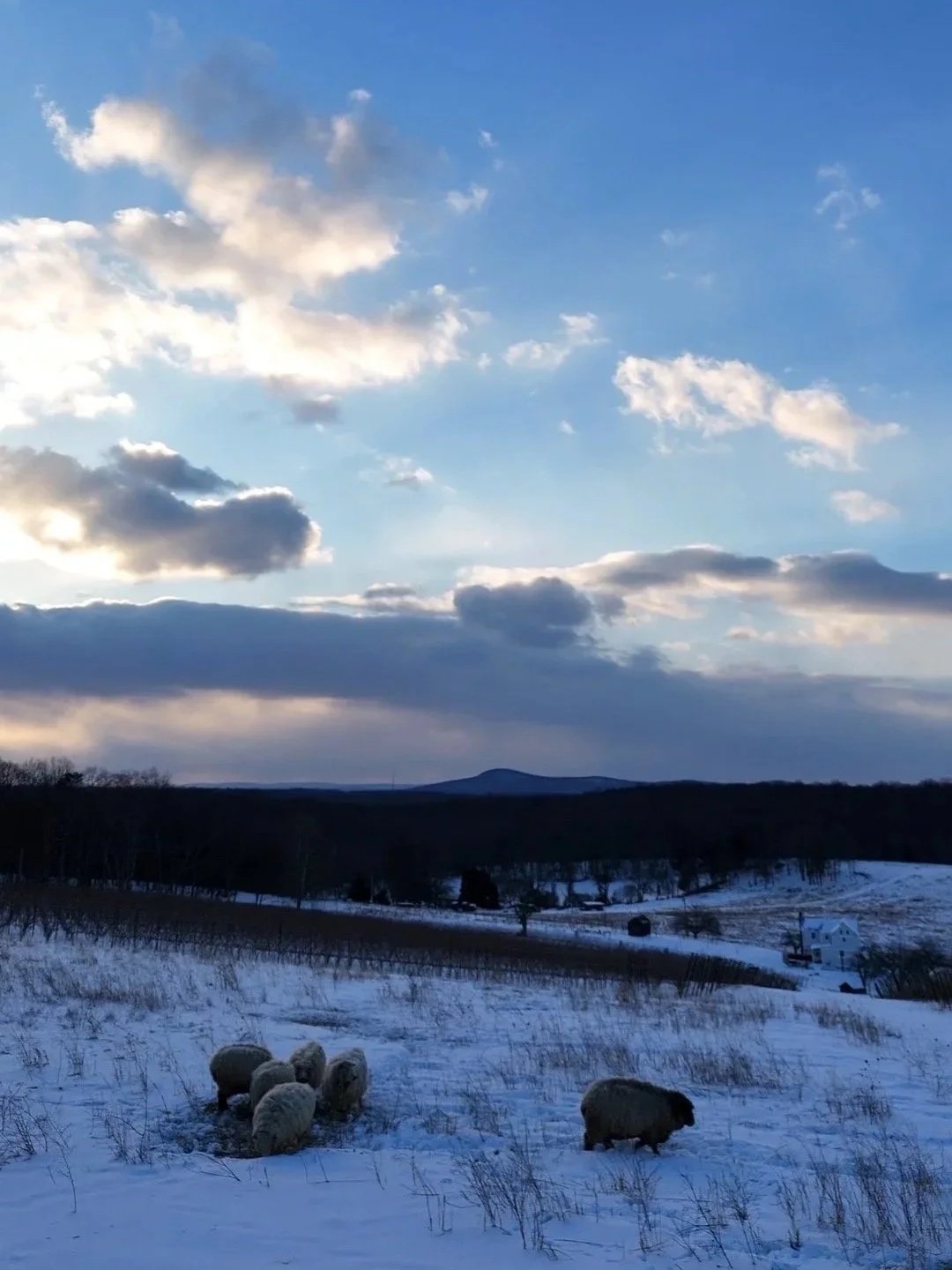
Burnt Hill Farm under a fresh blanket of snow.